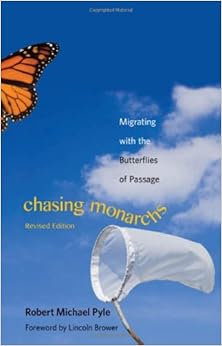
Although no one had ever followed North American monarch butterflies on their annual southward journey to Mexico and California, in the 1990s there were well-accepted assumptions about the nature and form of the migration. But to Robert Michael Pyle, a naturalist with long experience in monarch conservation, the received wisdom about the butterflies’ long journey just didn’t make sense. In the autumn of 1996 he set out to uncover the facts, to pursue the tide of “cinnamon sailors” on their long, mysterious flight.
Chasing Monarchs chronicles Pyle’s 9,000-mile journey to discover firsthand the secrets of the monarchs’ annual migration. Part road trip, part outdoor adventure, and part natural history study, Pyle’s book overturns old theories and provides insights both large and small regarding monarch butterflies, their biology, and their spectacular migratory travels. Since the book’s first publication, its controversial conclusions have been fully confirmed, and monarchs are better understood than ever before. The Afterword for this volume includes not only updated information on the myriad threats to monarch butterflies, but also various efforts under way to ensure the future of the world’s most amazing butterfly migration.
Review from Yale University Press:
http://yalepress.yale.edu/yupbooks/reviews.asp?isbn=9780300203875
Documentary: Tracking the Monarch Migration from Nova:
http://www.pbs.org/wgbh/nova/nature/monarch-migration.html

(http://wingedbeautydotcom.files.wordpress.com/2012/01/zablowbutt_first60-13_lrge.jpg)
Robert Michael Pyle's Facebook Page:
https://www.facebook.com/pages/Robert-Michael-Pyle/293832101900
Other Books by the author:
http://www.villagebooks.com/event/robert-michael-pyle-5/10/14
Recent Reading at Penn State, September 4, 2014:
http://psbehrend.psu.edu/news-events/events/september-4-robert-michael-pyle-reading
ID tools for Identifying Butterflies and Moths:
http://www.butterfliesandmoths.org/identification_tools
In the Washington State Magazine: Life Histories of the Butterflies of Cascadia:
http://wsm.wsu.edu/s/index.php?id=980

Some mentioned Butterflies of the West Coast of US:
Woodland Skipper:
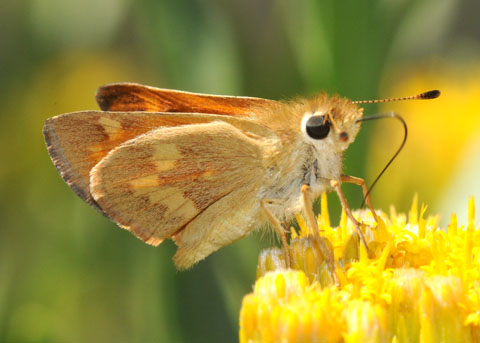
(http://nathistoc.bio.uci.edu/lepidopt/hesper/DSC_0557b.jpg)
Clouded Sulphur:

(http://www.butterfliesandmoths.org/sites/default/files/imagecache/gallery_for_colorbox/species_images/Colias_philodice2.jpg)
Compton tortoiseshell:
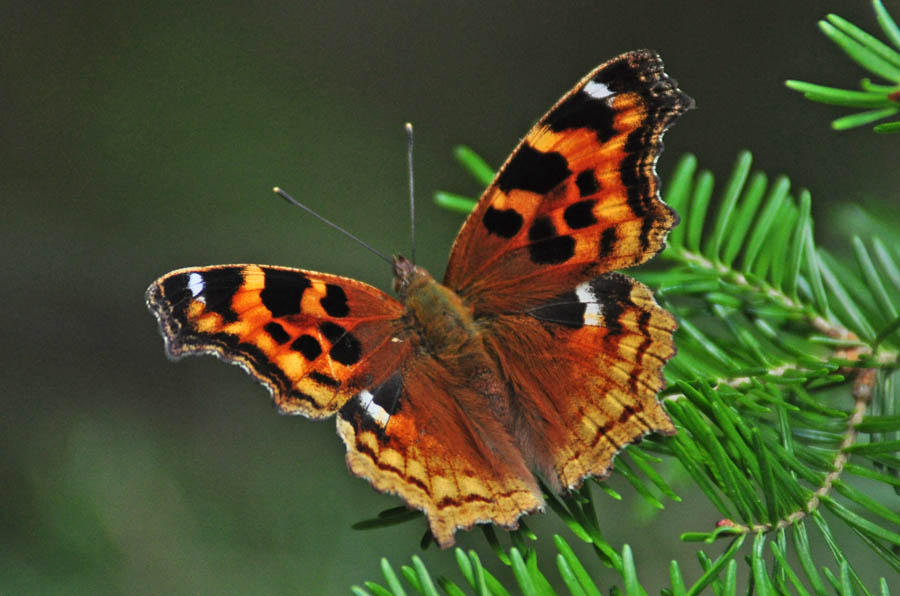
(http://www.thehibbitts.net/troy/photo/lepidoptera/compton.tortoiseshell.mn.cook.10.1a.jpg)
Becker's White:

(http://bugguide.net/images/raw/6ZKL1Z8L1Z4L2Z5HZR5L9ZILAZ2HBH8H2ZZLNZEH9Z5LRR4HGZQL1ZEHFHXLGZ7LNZILLR8L9ZMLFH.jpg)
* * * * * * * * * * *

Interview with Robert Michael Pyle:
http://podcastcafe.org/radiofreefundi/files/Bob-Pyle-Butterfly-Big-Year.html
Discussion Questions to Follow:
1. What predators do monarchs encounter along their journey? See pp 35, 41, 48
2. What plants are similar to milkweed? See page 26.
3. When did migration actually start? Discuss the "Columbus Hypothesis", page 50.
4. Discuss other things that challenge monarchs along the route, including weather, difficult water crossings, etc.
5. Discuss tagging of monarchs.
6. How have the changes in the landscape including damming effected migration patterns?
7. How did the author's theories about monarch migration influence research and lead to its confirmation?