Showing posts with label migration. Show all posts

Monday, April 11, 2016

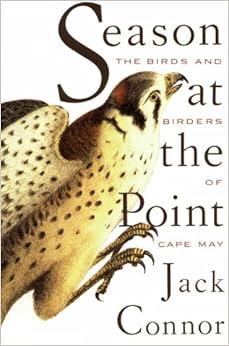
Season at the Point: The Birds and Birders of Cape May by J. Connor (1994)


**This book was recommended to us from a friend, who is active in the FL Audubon Society.

Summary from Amazon:
Cape May Point, New Jersey, is home to a natural phenomenon of stunning proportions. Each autumn millions of migrating birds converge here on their annual flight to wintering grounds as far away as Brazil and Peru. Season at the Point, the rich and telling story of the birds and birders of Cape May, evokes the sense of mystery and excitement that pervades the Cape as birders gather to count owls by the hundreds, hawks by the tens of thousands, and shorebirds and songbirds by the hundreds of thousands.


Available on Google Books:
Discussion Questions:
1. Is it possible to really understand migration patterns? What information would be needed to obtain this?
2. What were the some of the different approaches to birding amongst the birders, such as Al Nicholson versus others?
3. What role does banding play? To what degree does banding answer the questions to migration? What are some of its limitations?
4. Discuss the variability and difficulties in counting birds. Why was this type of information not considered to be solid data historically? 
5. Discuss the role of migration, orientation ability and timing and what it takes to successfully migrate.
6. Discuss the different birders, who they are and what perspectives do they bring.
7. How did the radar based data generated by the Clemson researchers change the way the hawk migration was viewed?
8. What impact has the hawk platform, bird counts and other birding events had on Cape May?


A 25th Anniversary of the writing of the book was celebrated on May 21, 2016 at The Grand Hotel in Cape May. The author did a reading and then led a panel discussion including several birding experts, who were highlighted in the book, including Pete Dunn, Paul Kerlinger, Jeff Boulton, and 
Pat and Clay Sutton. 


Friday, September 19, 2014

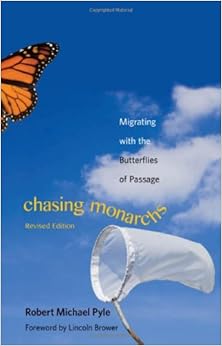
Chasing Monarchs: Migrating with the Butterflies of Passage by Robert Michael Pyle

Summary from Amazon:
Although no one had ever followed North American monarch butterflies on their annual southward journey to Mexico and California, in the 1990s there were well-accepted assumptions about the nature and form of the migration. But to Robert Michael Pyle, a naturalist with long experience in monarch conservation, the received wisdom about the butterflies’ long journey just didn’t make sense. In the autumn of 1996 he set out to uncover the facts, to pursue the tide of “cinnamon sailors” on their long, mysterious flight.
Chasing Monarchs chronicles Pyle’s 9,000-mile journey to discover firsthand the secrets of the monarchs’ annual migration. Part road trip, part outdoor adventure, and part natural history study, Pyle’s book overturns old theories and provides insights both large and small regarding monarch butterflies, their biology, and their spectacular migratory travels. Since the book’s first publication, its controversial conclusions have been fully confirmed, and monarchs are better understood than ever before. The Afterword for this volume includes not only updated information on the myriad threats to monarch butterflies, but also various efforts under way to ensure the future of the world’s most amazing butterfly migration.


Review from Yale University Press: 
http://yalepress.yale.edu/yupbooks/reviews.asp?isbn=9780300203875

Documentary: Tracking the Monarch Migration from Nova: 
http://www.pbs.org/wgbh/nova/nature/monarch-migration.html
(http://wingedbeautydotcom.files.wordpress.com/2012/01/zablowbutt_first60-13_lrge.jpg)

Robert Michael Pyle's Facebook Page
https://www.facebook.com/pages/Robert-Michael-Pyle/293832101900

Other Books by the author: 
http://www.villagebooks.com/event/robert-michael-pyle-5/10/14

Recent Reading at Penn State, September 4, 2014: 
http://psbehrend.psu.edu/news-events/events/september-4-robert-michael-pyle-reading

ID tools for Identifying Butterflies and Moths:
http://www.butterfliesandmoths.org/identification_tools

In the Washington State Magazine: Life Histories of the Butterflies of Cascadia:
http://wsm.wsu.edu/s/index.php?id=980


Some mentioned Butterflies of the West Coast of US:
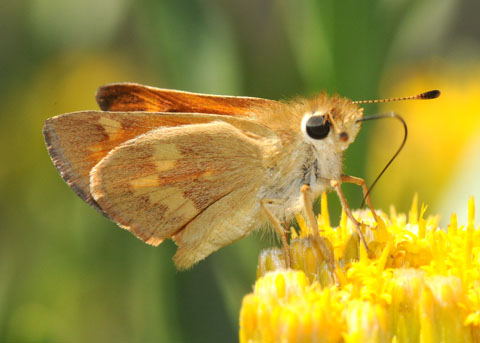
Woodland Skipper:
(http://nathistoc.bio.uci.edu/lepidopt/hesper/DSC_0557b.jpg)
Clouded Sulphur:
(http://www.butterfliesandmoths.org/sites/default/files/imagecache/gallery_for_colorbox/species_images/Colias_philodice2.jpg)

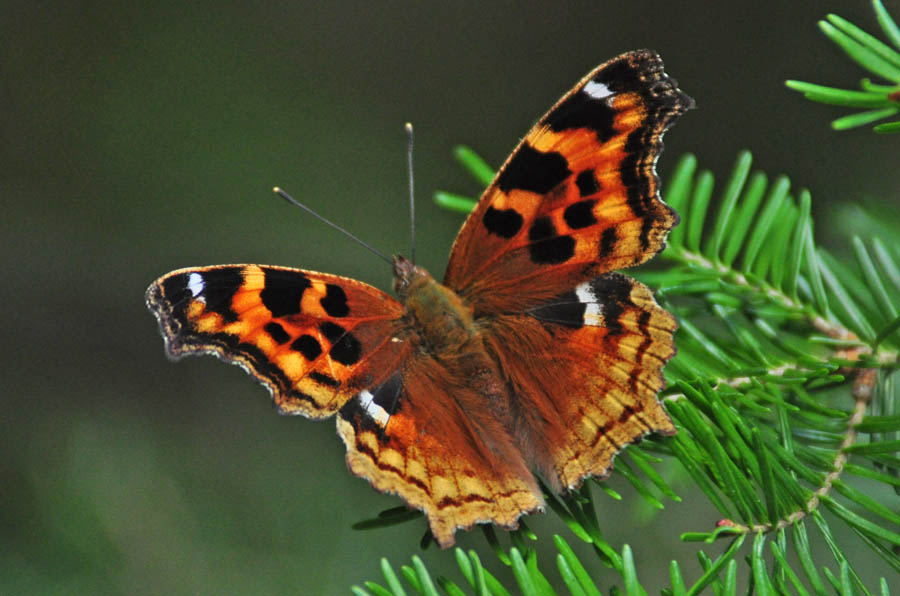
Compton tortoiseshell: 

(http://www.thehibbitts.net/troy/photo/lepidoptera/compton.tortoiseshell.mn.cook.10.1a.jpg)

Becker's White: 
(http://bugguide.net/images/raw/6ZKL1Z8L1Z4L2Z5HZR5L9ZILAZ2HBH8H2ZZLNZEH9Z5LRR4HGZQL1ZEHFHXLGZ7LNZILLR8L9ZMLFH.jpg)


*   *   *   *   *   *   *   *   *   *   * 


Interview with Robert Michael Pyle: 
http://podcastcafe.org/radiofreefundi/files/Bob-Pyle-Butterfly-Big-Year.html

Discussion Questions to Follow:
1. What predators do monarchs encounter along their journey? See pp 35, 41, 48
2. What plants are similar to milkweed? See page 26.
3. When did migration actually start? Discuss the "Columbus Hypothesis", page 50.
4. Discuss other things that challenge monarchs along the route, including weather, difficult water crossings, etc. 
5. Discuss tagging of monarchs.
6. How have the changes in the landscape including damming effected migration patterns?
7. How did the author's theories about monarch migration influence research and lead to its confirmation?


Monday, July 7, 2014

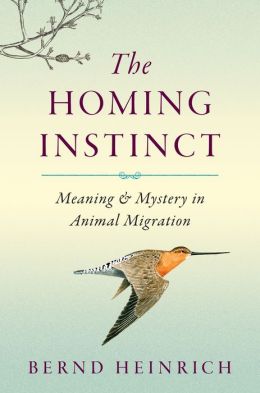
Bernd Henrich's The Homing Instinct: Meaning and Mystery in Animal Migration


Book Summary provided by Good Reads:
"Heinrich explores the fascinating science chipping away at the mysteries of animal migration: how geese imprint true visual landscape memory; how scent trails are used by many creatures, from fish to insects to amphibians, to pinpoint their home if they are displaced from it; and how the tiniest of songbirds are equipped for solar and magnetic orienteering over vast distances. Most movingly, Heinrich chronicles the spring return of a pair of sandhill cranes to their home pond in the Alaska tundra. With his trademark “marvelous, mind-altering” prose (Los Angeles Times), he portrays the unmistakable signs of deep psychological emotion in the newly arrived birds—and reminds us that to discount our own emotions toward home is to ignore biology itself." 

Washington Post Review: "The Homing Instinct: Meaning and Mystery in Animal Migration by Bernd Heinrich and The Surprising Lives of Birds and What they reveal about being Human by Noah Stryckern" by David Gessner: http://www.washingtonpost.com/opinions/the-homing-instinct-meaning-and-mystery-in-animal-migration-by-bernd-heinrich-and-the-surprising-lives-of-birds-and-what-they-reveal-about-being-human-by-noah-stryckern/2014/05/02/290cc28c-ced1-11e3-a6b1-45c4dffb85a6_story.html

Q & A with Bernd Heinrich on A Way to Garden (also Podcast available)
http://awaytogarden.com/homing-instinct-bernd-heinrich/

"Do Humans have some kind of Homing Instincts . . ," Scientific American, Oct. 21, 1998
http://www.scientificamerican.com/article/do-humans-have-some-kind/

PBS Nature Video: "Extraordinary Cats: Homing Instinct"
http://www.pbs.org/wnet/nature/episodes/extraordinary-cats/homing-instinct/2170/

Homing, Migration and Navigation: Cornell Lab of Ornithology:
http://www.birds.cornell.edu/AllAboutBirds/studying/migration/navigation

Discussion Questions:
1. How are the topics, migration and homing similar and different?
2. Do humans have a homing instinct?
3. What positive and negative lessons can we as humans learn from the herding mentality?
4. How do animal and human home making and it's implications compare?
5. Discuss what you found surprising? Consider the eel, grasshopper, orb weaver spider, passenger pigeon, godwit, moth, etc.
6. Discuss the different means of migration including smell, magnetic, stars and sun.
7. Discuss the interaction of animals in their home territories including the effect of the American Chestnut and also bed bugs and other parasites in nests and homes.
8. Discuss predator and prey relationships as with the spider and passenger pigeon.
9. Discuss the successes and disasters of home building and site choices of animals versus humans including the Suriname trip.

(Pic from: http://4.bp.blogspot.com)