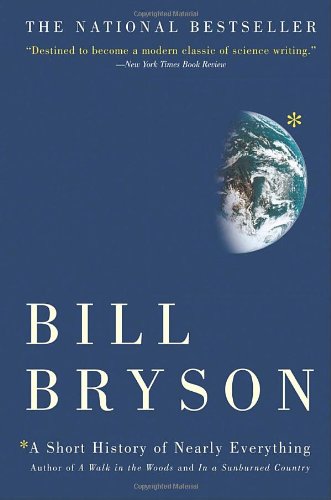
Summary from Random House:
"In A Short History of Nearly Everything, the bestselling author of One Summer, confronts his greatest challenge yet: to understand—and, if possible, answer—the oldest, biggest questions we have posed about the universe and ourselves. Taking as his territory everything from the Big Bang to the rise of civilization, Bryson seeks to understand how we got from there being nothing at all to there being us. The result is a sometimes profound, sometimes funny, and always supremely clear and entertaining adventure in the realms of human knowledge, as only Bill Bryson can render it."
NY Times Review: http://www.nytimes.com/2003/05/18/books/atoms-the-size-of-peas.html
Bookrags materials: http://www.bookrags.com/studyguide-a-short-history-of-nearly-everything/#gsc.tab=0
Random House Teacher Guide:
https://www.randomhouse.com/catalog/teachers_guides/9780767908184.pdf
Author's Website: https://www.penguin.co.uk/authors/bill-bryson/1017933/
Discussion Questions from Litlovers:
1. This book presents science as a series of questions—mostly unanswered. Is this surprising to you? How was science presented to you when you were in school?
2. Bryson mentions that, several times in the past, scientists thought that all the big questions were answered. Some even believe we have reached that point today. Still others wonder if we might soon reach the limits of our intellectual ability to understand the strangeness of atomic particles or explore multiple universes. Any thoughts?
3. A major theme of the book is resistance to new scientific ideas despite solid evidence for them. Bryson gives a number of examples—the Big Bang and plate tectonics are two. What other theories faced initial rejection?
2. Bryson mentions that, several times in the past, scientists thought that all the big questions were answered. Some even believe we have reached that point today. Still others wonder if we might soon reach the limits of our intellectual ability to understand the strangeness of atomic particles or explore multiple universes. Any thoughts?
3. A major theme of the book is resistance to new scientific ideas despite solid evidence for them. Bryson gives a number of examples—the Big Bang and plate tectonics are two. What other theories faced initial rejection?
4. Follow-up to Question 3: At the same time, Bryson addresses the idea of scientists clinging to widely accepted but disproven ideas—a young earth and Ether are two that come to mind. What are some of the others in the book?
• Why do you think scientists are resistant to change?
• Are scientists any different from lay people in their resistance to change?
• What current widely held idea do you think might be disproven in the future?
• Are scientists any different from lay people in their resistance to change?
• What current widely held idea do you think might be disproven in the future?
5. Bryson often cites examples of global crises that may have influenced the Earth in the past—meteor strikes, salinity crisis, volcanoes, changes in solar output. How does this relate to the current consideration of global warming?
6. Follow-up to Question 5: Considering the Bryson's examples of powerful global forces beyond human control—including hurricanes, plate tectonics, earthquakes, volcanic eruptions, and ice ages—do you think differently about human ability to control what happens on earth? To what extent are we "masters" of the earth?
7. What is the connection between human beings and extinction of other species? Consider, for instance, how the dodos and passenger pigeons became extinct? Bryson makes a number of statements on the subject. What do you think?
6. Follow-up to Question 5: Considering the Bryson's examples of powerful global forces beyond human control—including hurricanes, plate tectonics, earthquakes, volcanic eruptions, and ice ages—do you think differently about human ability to control what happens on earth? To what extent are we "masters" of the earth?
7. What is the connection between human beings and extinction of other species? Consider, for instance, how the dodos and passenger pigeons became extinct? Bryson makes a number of statements on the subject. What do you think?
• Over the last 50,000 years or so, wherever we have gone, animals have tended to vanish, in often astonishingly large numbers.
• The people who were most intensely interested in the world’s living things were the ones most likely to extinguish them.
• It’s an unnerving thought that we may be the living universe’s supreme achievement and it’s worst nightmare simultaneously.
• We enjoy not only the privilege of existence but also the singular ability to appreciate it and even to make it better.
• The people who were most intensely interested in the world’s living things were the ones most likely to extinguish them.
• It’s an unnerving thought that we may be the living universe’s supreme achievement and it’s worst nightmare simultaneously.
• We enjoy not only the privilege of existence but also the singular ability to appreciate it and even to make it better.
8. How has this book affected your thinking about evolution? Do you agree that evolution may be "a lottery" or that, as human beings, "we are not the culmination of anything”?
9. Do a little research into Drake’s equation for the possibility of life on other worlds. Do you think life in the universe is inevitable or rare? Why? How about other complex (multi-cellular) life? How about intelligent life?
10. Bryson presents scientists as human beings with very human stories. Many died unhappy receiving no recognition or credit for their work. How would you feel if this happened to you? Which story touches you the most?
11. Consider the common question: “Why are there so few women scientists?” Does this book agree there is a shortage, or does it tell us why we don't hear about female scientists? Consider doing some research on Mme Lavoisier, Curie, or Franklin.
(Questions adapted from the Penguin Random House Teachers Guide.)
9. Do a little research into Drake’s equation for the possibility of life on other worlds. Do you think life in the universe is inevitable or rare? Why? How about other complex (multi-cellular) life? How about intelligent life?
10. Bryson presents scientists as human beings with very human stories. Many died unhappy receiving no recognition or credit for their work. How would you feel if this happened to you? Which story touches you the most?
11. Consider the common question: “Why are there so few women scientists?” Does this book agree there is a shortage, or does it tell us why we don't hear about female scientists? Consider doing some research on Mme Lavoisier, Curie, or Franklin.
(Questions adapted from the Penguin Random House Teachers Guide.)